
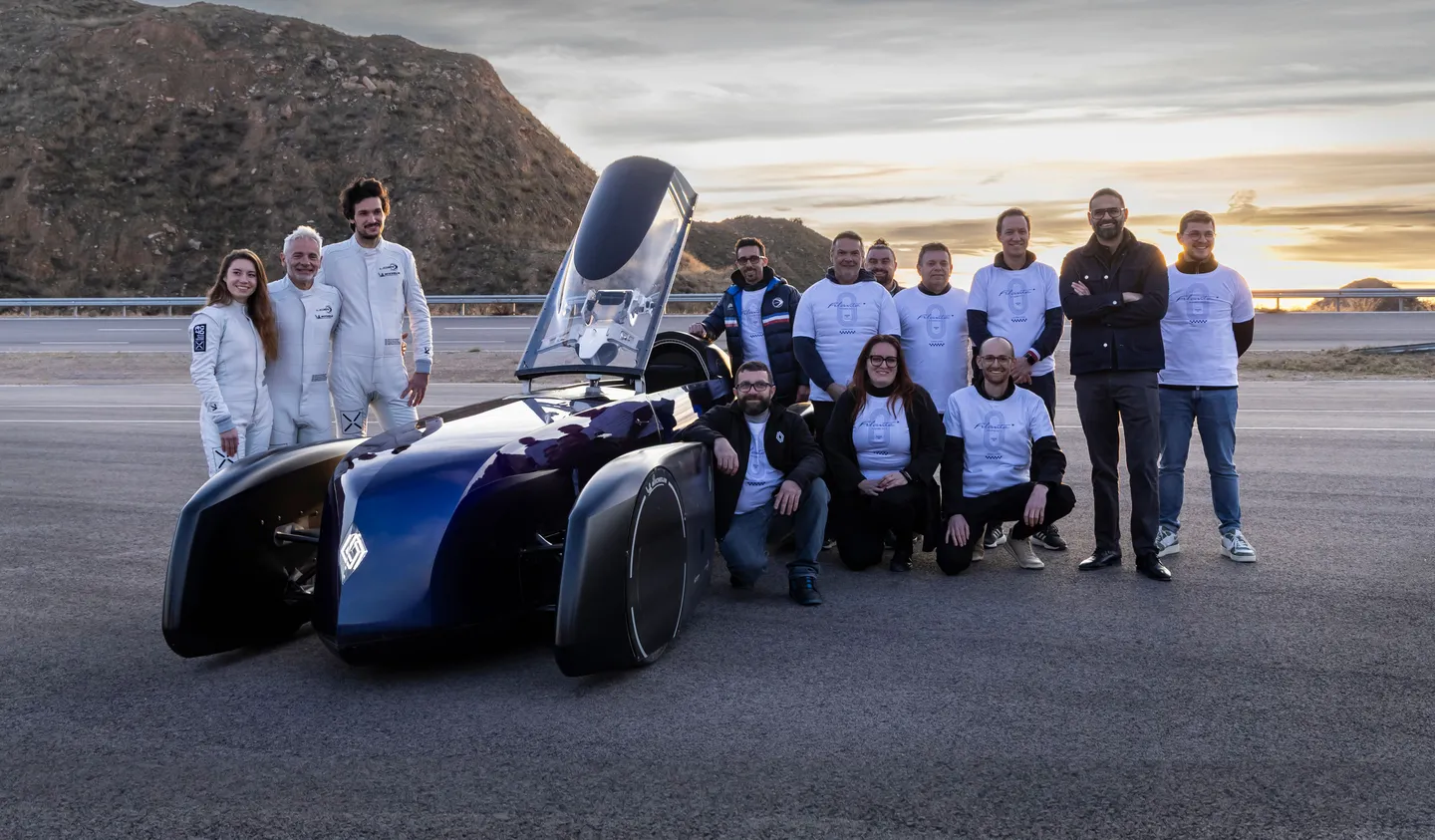
Renault has achieved a major milestone in electric vehicle efficiency with its experimental Renault Filante Record 2025 demo car, driving 1,008 kilometres on a single battery charge while maintaining an average speed of 102 km/h during a certified test in Morocco. This breakthrough run underscores the potential of next-generation EV design focused on efficiency rather than just battery size.
Renault Filante Record 2025: A New Benchmark for EV Efficiency
On 18 December 2025, the Filante Record 2025 demonstrator completed its range run at the UTAC Ceram test centre in Oued Zem, Morocco, covering 1,008 km (626 miles) in under 10 hours at an average speed of approximately 102 km/h without recharging.
Unlike many range records achieved at very low speeds, the goal of this test was to demonstrate real-world, sustained highway efficiency with a standard production battery size.How the Filante Record Car Achieved Its Result
Standard-Size Battery, Exceptional Range
Renault used an 87 kWh battery—the same capacity as found in the production Renault Scenic E-Tech Electric—to power the Filante Record car during the run.
At the end of the 1,008 km run, the vehicle still retained 11% battery charge, which could have supported an additional approx. 120 km (75 miles) at similar speeds.
Energy Consumption and Real-World Efficiency
The Filante Record 2025 achieved an extraordinarily low energy consumption rate of about 7.8 kWh per 100 km over the full distance at high speed.
This figure represents how Renault prioritized efficiency-oriented engineering—including range optimization at realistic driving speeds—over simply maximizing total distance with large battery packs.
Engineering That Made the Record Possible
Lightweight Construction
The Filante Record 2025 weighs approximately 1,000 kg, thanks to extensive use of lightweight materials such as carbon fibre, aluminium alloys and advanced composites.
Aerodynamic Optimization
Renault engineers refined the car’s form through detailed aerodynamics work, reducing drag to help the vehicle cut through air more efficiently at highway speeds.
Advanced Technologies
The concept incorporates steer-by-wire and brake-by-wire systems to remove mechanical linkages and reduce overall weight, along with bespoke low rolling resistance tyres developed in partnership with Michelin.
Collaborative Development
Specialized partners such as Ligier assisted with the vehicle’s construction and chassis development.
What the Efficiency Run Means for Future EVs
Renault characterises the Filante Record project as a technology laboratory rather than a preview of a production model. The insights gained are intended to inform future EV architecture, aerodynamics and energy management strategies for Renault’s upcoming electric vehicles.
The achievement demonstrates that significant real-world range improvements can be achieved through efficiency gains, not simply by enlarging battery packs—a direction that could influence how automakers prioritise EV design in the years ahead.
Conclusion: A Milestone for Electric Mobility
The Renault Filante Record 2025 has set a new EV efficiency benchmark, covering 1,008 km on a single 87 kWh charge at sustained highway speeds. The run confirms that intelligent engineering—especially in aerodynamics, lightweighting and systems optimization—can push electric vehicle performance to new heights without relying on oversized batteries.
This achievement highlights a future where EVs deliver exceptional real-world range through smarter design, positioning Renault at the forefront of efficiency-driven innovation in electric mobility.
FAQs: Renault Filante Record 2025 EV Efficiency Record
1. What is the Renault Filante Record 2025?
The Renault Filante Record 2025 is an experimental electric demonstrator developed by Renault to test and showcase extreme energy efficiency. It is not a production car but a technology laboratory designed to explore how far EV range can be extended through aerodynamics, lightweight construction, and intelligent design.
2. How far did the Renault Filante Record 2025 travel on a single charge?
The Renault Filante Record 2025 covered 1,008 kilometres on a single charge during a certified test conducted at UTAC’s Oued Zem circuit in Morocco on 18 December.
3. What was the average speed during the 1,008 km EV record run?
The vehicle maintained an average speed of 102 km/h, proving that long-distance electric driving at continuous highway speeds is possible without recharging.
4. What battery capacity was used in the Filante Record 2025?
Renault used an 87 kWh battery, the same capacity as the production Renault Scenic E-Tech Electric. At the end of the test, 11% battery charge remained, which could have supported approximately 120 additional kilometres of driving.
5. Why is the Renault Filante Record 2025 important for future EVs?
The record demonstrates that improving efficiency, aerodynamics, and weight reduction can significantly increase real-world EV range without increasing battery size. The data collected will help Renault develop more efficient production EVs, reducing costs and environmental impact.
Read EV news here.